
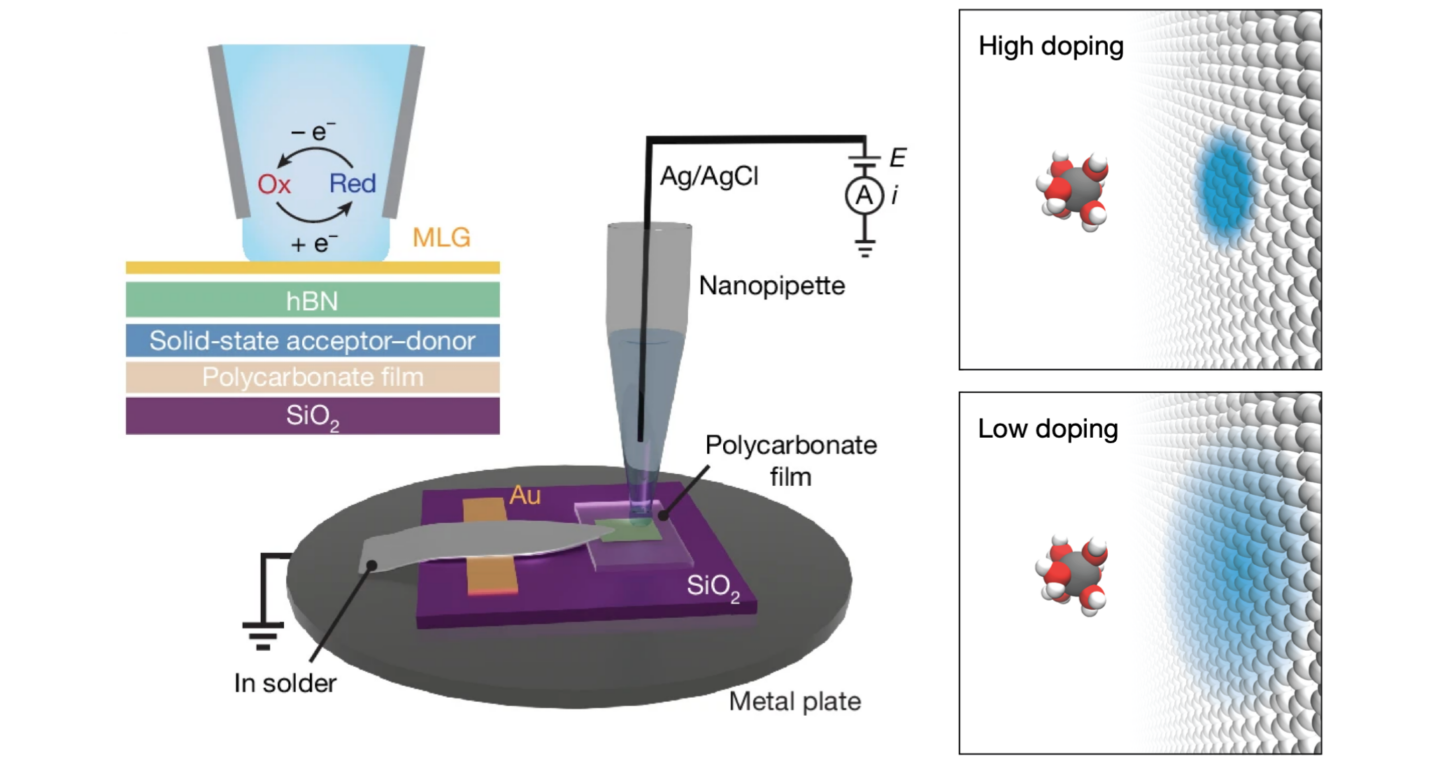
A new study from researchers in Berkeley Lab’s Chemical Sciences Division (CSD) and Materials Sciences Division (MSD) shows that the electronic structure of an electrode plays a larger role in chemical reactions than previously understood. The work, published in Nature, revises a central assumption in electrochemistry and could inform the design of more efficient energy and catalytic systems.
Electron transfer reactions underpin processes ranging from batteries to catalysis. These reactions are commonly described by Marcus theory, which links reaction rates to the reorganization energy, the energy required to rearrange the environment during charge transfer. This energy has long been attributed primarily to the liquid (electrolyte), with the electrode assumed to play a passive role.
Here, researchers led by David Limmer and D. Kwabena Bediako directly test that assumption using atomically thin, graphene-based heterostructures. By tuning the electrode’s electronic density of states, they measure corresponding changes in electron transfer rates.
The results show that rate changes cannot be explained solely by the number of available electronic states. Instead, the dominant effect is a shift in the reorganization energy itself, driven by how the electrode screens charge at the interface. This effect was predicted theoretically in 2024 by Berkeley graduate student Leonardo Coello Escalante and Limmer in a paper in Nano Letters. Using a novel electrochemical device fabrication, graduate student Sonal Maroo was able to confirm it quantitatively.
At the microscopic level, materials with a high density of states more effectively localize charge, stabilizing the transition state and lowering the energetic cost of the reaction. Lower-density materials produce a more diffuse response and higher reorganization energies.
These findings show that reorganization energy depends strongly on the electrode’s electronic structure, not just the electrolyte. Accounting for this effect helps resolve longstanding discrepancies between theory and experiment and provides a more complete framework for interfacial charge transfer.
The work points to new strategies for controlling chemical reactivity at surfaces. By tailoring electrode electronic properties, particularly in low-dimensional materials such as graphene, researchers may be able to tune reaction rates for applications in energy storage, catalysis, and photoelectrochemistry.
Funding: At LBNL, this research was supported in part by the Chemical Physics Research: Condensed Phase and Interfacial Molecular Science Program and the Fundamentals of Semiconductor Nanowire Program.
Researchers: S. Maroo, L. Coello Escalante, Y. Wang, M.P. Erodici, J.N. Nessralla, A. Tabo, K. Xu, D.T. Limmer, and D.K. Bediako (Chemical Sciences Division and Materials Sciences Division, Lawrence Berkeley National Laboratory, and University of California, Berkeley); T. Taniguchi (Research Center for Materials Nanoarchitectonics, National Institute for Materials Science); and K. Watanabe (Research Center for Electronic and Optical Materials, National Institute for Materials Science).
Publication: S. Maroo, L. Coello Escalante, Y. Wang, M. P. Erodici, J. N. Nessralla, A. Tabo, T. Taniguchi, K. Watanabe, K. Xu, D. T. Limmer, and D. K. Bediako, Electronic origin of reorganization energy in interfacial electron transfer, Nature (2026).
