
Scientific Achievement
- Researchers in the Condensed Phase and Interfacial Molecular Science (CPIMS) program
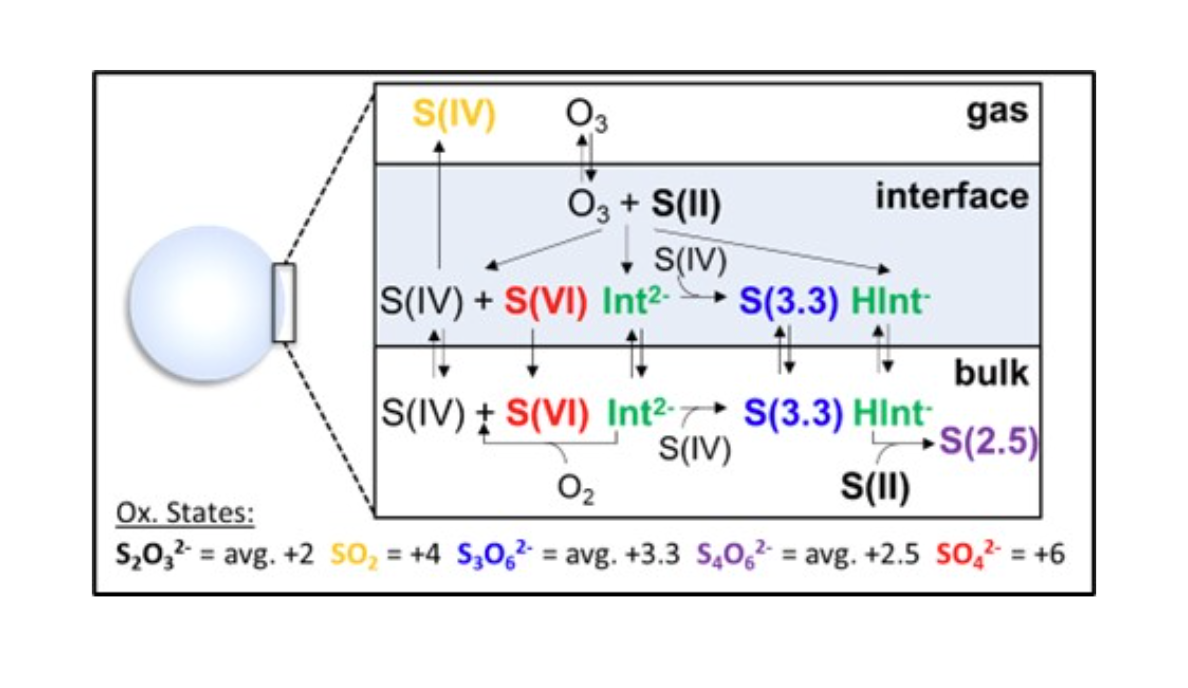
combined single droplet mass spectrometry, ambient pressure X-ray photoelectron spectroscopy and second harmonic generation has enabled an exquisitely detailed molecular view of the multiphase oxidation mechanism of thiosulfate by ozone at aqueous surfaces
Significance and Impact
- Developed an entirely new mechanism for thiosulfate oxidation by ozone that resolves the importance of surface partitioning of doubled charged anions for the overall reaction mechanis
- This work has implications for mining wastewater remediation, atmospheric chemistry, and understanding other complex reaction mechanisms in multiphase environments
Research Details
- Single droplet mass spectrometry quantifies multiphase reaction kinetics. To unravel the mechanism requires understanding the interface propensity of thiosulfate and its reaction products
- Measured using deep UV second harmonic generation to obtain Gibb’s adsorption free energies
- Ambient pressure X-ray photoemission is used to quantify the concentration of salt species at the interface
- Information from these three techniques constrains a detailed and predictive kinetic model.
- Primary reaction between thiosulfate and ozone occurs at the interface and in the bulk, with the contribution of the interface decreasing from ~65% at pH 5 to ~45% at pH 13.
- Sulfate, the major product and an important species in atmospheric processes is produced by two different pathways at pH 5, one with a contribution from the interface of >70% and the other occurring predominantly in the bulk (>98%)
Publication Details
A. M. Deal, F. Bernal, A. Siebert, A. M. Prophet, M. Lopez Luna, M. Blum, R. J. Saykally and K. R. Wilson, Chemical Sciences (2025).
Work was performed at Lawrence Berkeley National Lab, and the Advanced Light Source.
