
Scientific Achievement
- Researchers in the Condensed Phase and Interfacial Molecular Science (CPIMS) program
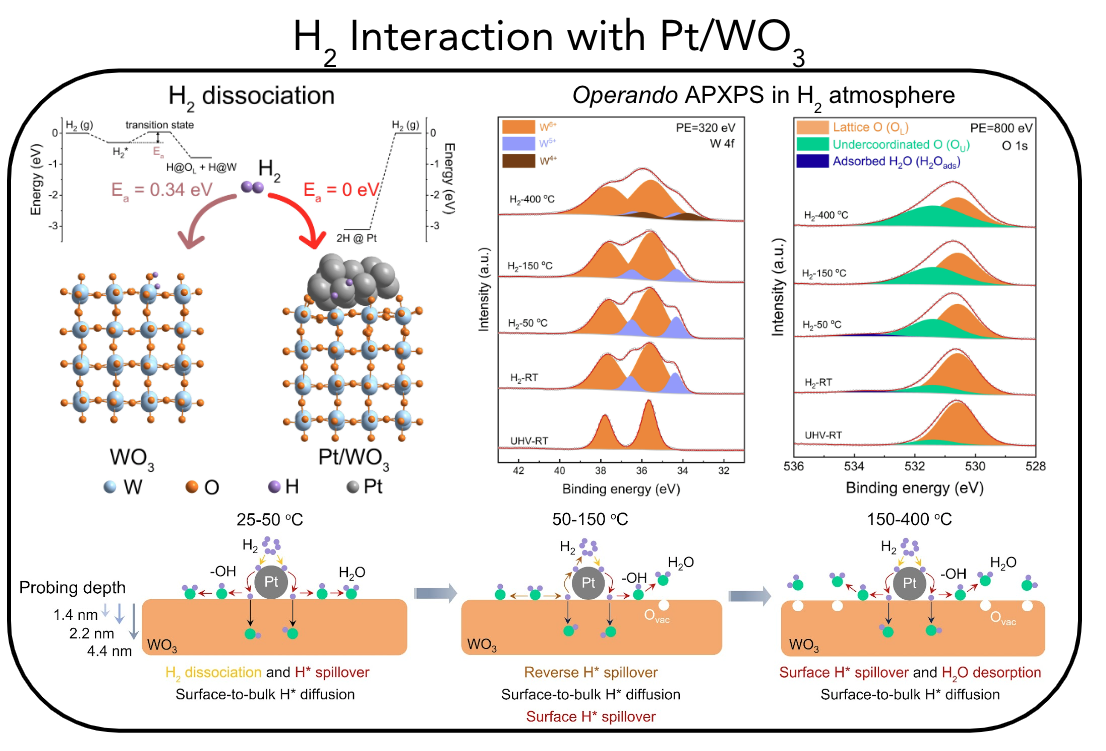
demonstrated an in-depth exploration of Pt-induced hydrogen spillover mechanisms on tungsten oxide surfaces, employing a combination of operando ambient pressure X-ray photoelectron spectroscopy (APXPS), density functional theory calculations, and microkinetic modeling
Significance and Impact
- Significant gaps remain in understanding the fundamental surface reactions governing hydrogen spillover on reducible metal oxides. This work provides comprehensive elucidation of hydrogen interaction mechanisms with reducible metal oxides, which offers novel insights that govern hydrogen behavior and their implications for catalytic activity
Research Details
- Computational findings show that Pt metal clusters significantly facilitate H2 activation and dissociation under conditions in which the same behaviors of H2 are kinetically inhibited on the bare WO3 surfaces
- Upon exposure to 5 mTorr of H2 at room temperature, operando APXPS results show clear signs of hydrogen spillover on the Pt/WO3 surface due to W reduction with the formation of H* intermediates
- At elevated temperatures, Pt-facilitated hydrogen spillover involves oxygen vacancy formation via H2Oads desorption and hydrogen migration through reverse spillover and surface-to-bulk diffusion of hydrogen atoms, which was further supported by microkinetic modeling of the steady-state surface coverage
Publication Details
Li, H.; Abdelgaid, M.; Paudel, J.R.; Holzapfel, N.P.; Augustyn, V.; McKone, J.R.; Mpourmpakis , G.; Crumlin, E.J. J., American Chemical Society (2025).
Work was performed at Lawrence Berkeley National Lab, and the University of Pittsburgh.
