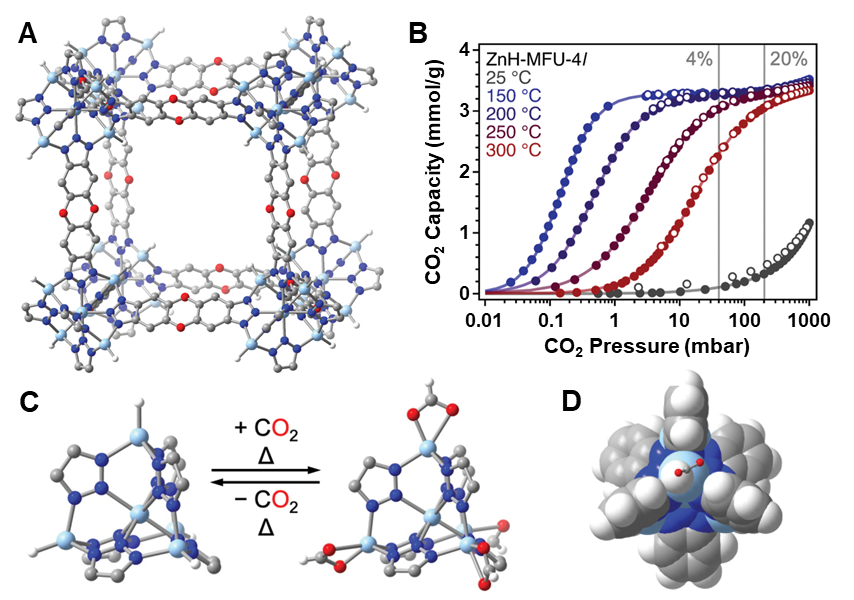
The Separating Complex Mixtures at Operando Temperatures program addresses one of the most energy-intensive challenges in modern industry: chemical separations. Current approaches, such as distillation, account for a substantial fraction of global energy use, motivating the need for fundamentally new strategies that can operate efficiently under realistic process conditions. This program focuses on the design and understanding of advanced metal–organic frameworks (MOFs) that enable highly selective, high-throughput separations at elevated temperatures and pressures. By leveraging both chemisorptive and physisorptive interactions within tunable porous materials, the research seeks to establish new paradigms for separating complex gas mixtures relevant to processes such as methane upgrading and hydrogen production. Through a combination of in situ spectroscopy, diffraction, calorimetry, and multicomponent breakthrough analysis, the program elucidates the thermodynamic and kinetic principles governing adsorption and selectivity under operando conditions. These insights will enable predictive control of separation performance and guide the development of next-generation materials and processes that dramatically reduce energy consumption while enhancing U.S. manufacturing competitiveness.