
Scientific Achievement
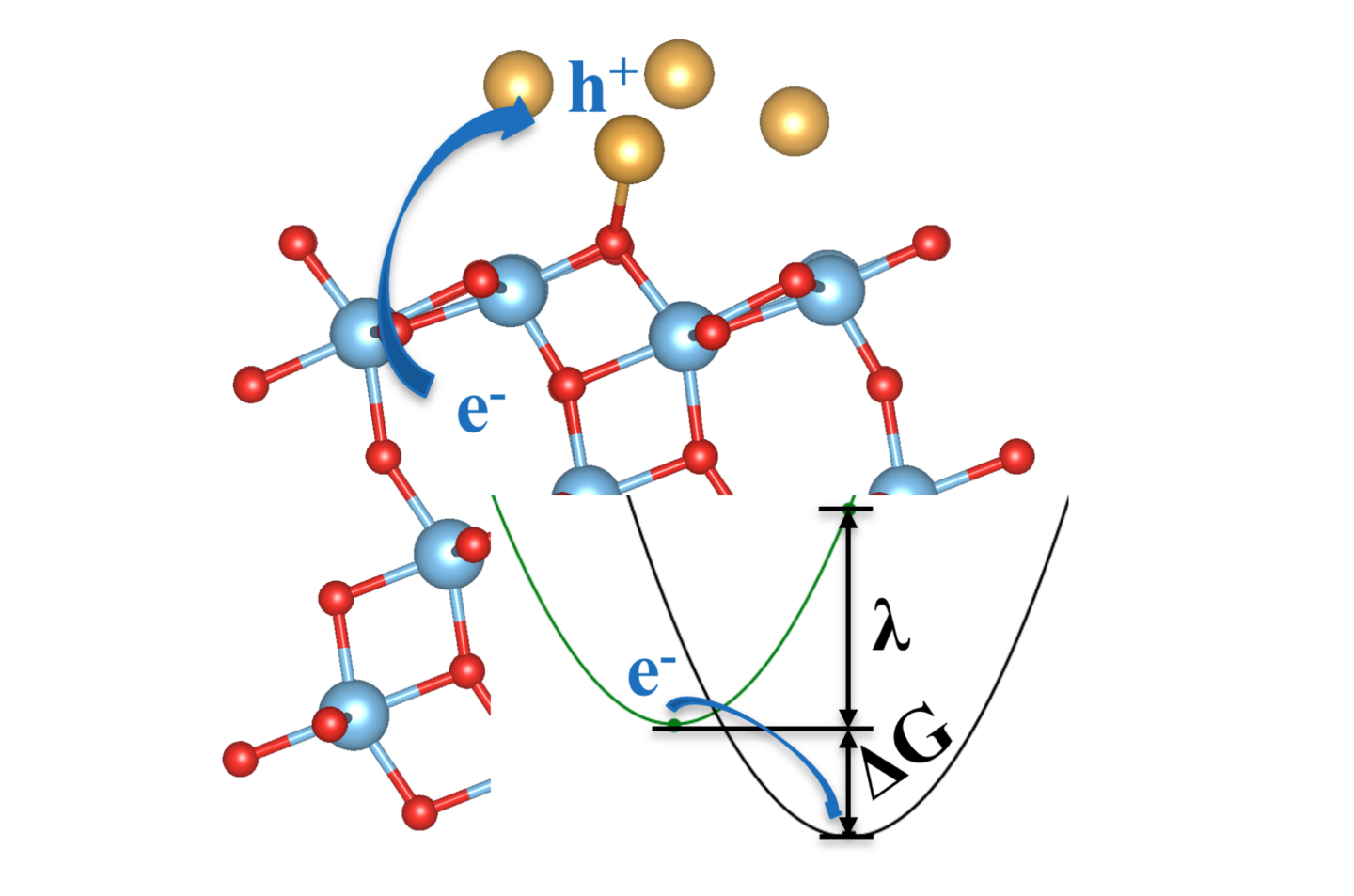
- Researchers in the Atomic, Molecular and Optical Sciences (AMOS) program developed a predictive computational framework to model site-specific charge recombination at complex metal–semiconductor interfaces
Significance and Impact
- By extending real-space Constrained Density Functional Theory (CDFT) combined with Marcus theory beyond its traditional domains in small molecular systems, this new capability enables computationally efficient prediction of recombination pathways and timescales
Research Details
-
Real-space CDFT was developed and applied to study ultrafast charge recombination mechanism and timescale at the Au nanoparticle/TiO₂ semiconductor interface
-
CDFT and Marcus theory results was validated against the more established nonadiabatic molecular dynamics (NAMD) results, where both methods can reproduce charge transfer trends while CDFT cuts the computation time down by nearly 80%
-
The charge-separated state features a bipolaron, with recombination mechanism dominated by TiO₂ LUMO to Au HOMO transitions, via the spatial overlap at the interfacial layer
-
Scaling trends of reorganization energy (λ) and free energy change (ΔG) was established in closed-shell systems, and the challenge of forecasting ΔG in open-shell systems was identified
Publication Details
D. M. Glenna, C. Mora Perez, E. Hermosillo, H. Zhao, J. Qian. The Journal of Physical Chemistry Letters (2026).
DOI: 10.1021/acs.jpclett.5c02905
Work was performed at Lawrence Berkeley National Laboratory, and in part at NERSC.
