
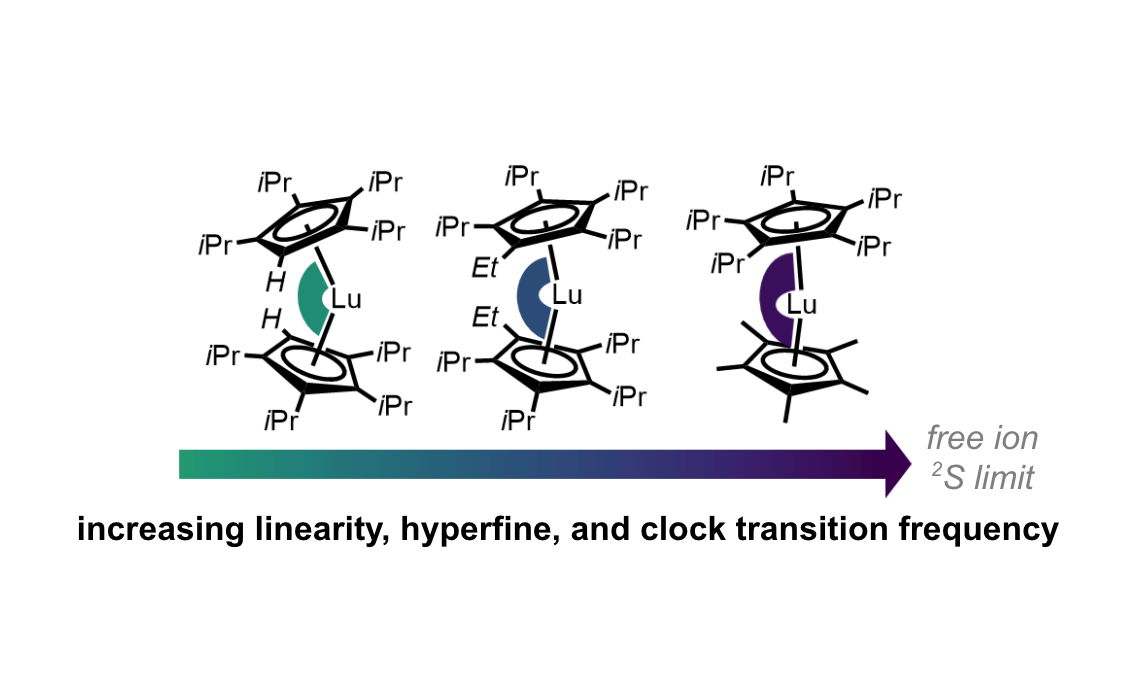
Scientific Achievement
- Researchers in the Heavy Element Chemistry (HEC) program identified a series of divalent lutetium metallocene complexes exhibiting spin properties approaching those of free rare earth ions, powerhouses of modern trapped ion-based quantum computing
Significance and Impact
- Chemical design was used to tune the structure of rare earth (lutetium) complexes and reveal geometry-magnetism correlations towards the goal of enhancing coherence times
Research Details
- Increasingly linear divalent lutetium metallocene complexes displayed 4.17 GHz, 4.30 GHz, and 4.38 GHz hyperfine couplings
- High-field, high-frequency electron paramagnetic resonance (Maglab) was used to identify such large hyperfine coupling values
- Ligand steric modifications allow tuning of overall structural geometry and core magnetic properties
D. X. Ngo, K. R. McClain, J. Hruby, Y. J. Franzke, K. Kundu, H. Kwon, C. A. Gould, B. G. Harvey, S. Hill, J. R. Long, Journal of the American Chemical Society (2025).
Work was performed at Lawrence Berkeley National Lab, University of California Berkeley, Florida State University, and the National High Magnetic Field Laboratory.
