
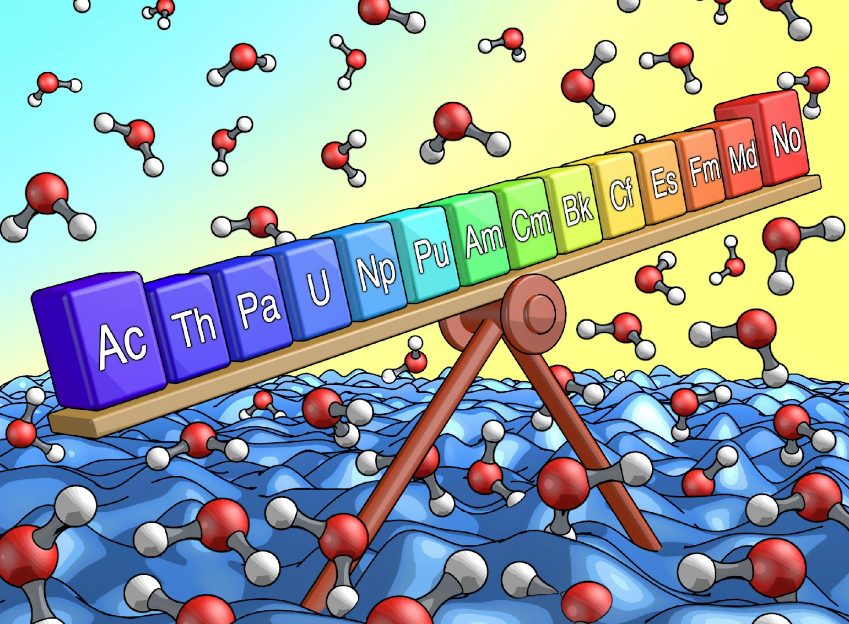
Scientific Achievement
- Uncharted Territory: At the bottom of the periodic table chemical properties are expected to deviate from established trends
- Experimental Challenges: Measurements are extremely difficult for elements with Z>100
- Breakthrough Technique: LBNL developed a method for direct molecule formation and identification for elements produced atom-at-a-time in nuclear reactions
- First-of-a-Kind Measurement: Molecular species containing H2O and N2 ligands produced and directly identified in a comparative study of actinium (Z=89) and nobelium (Z=102)
Significance and Impact
- Clear Insights: Removes reliance on species assumptions, providing direct understanding of observed chemical reactivity
- Comparative Study: First direct comparison of early and late actinide ion chemical properties. Both react similarly with H2O, but differently with N2
- Historic Identification: First direct molecule identification for an element with Z>99
- Deeper Exploration: Enables further study of the periodic table’s uncharted territories
- New Frontiers: Opens the door to a new generation of superheavy element chemistry
Research Details
- The periodic table provides an intuitive framework for understanding chemical properties. However, its traditional patterns may break down for the heaviest elements occupying the bottom of the chart. The large nuclei of actinides (Z > 88) and superheavy elements (Z ≥ 104) give rise to relativistic effects that are expected to substantially alter their chemical behaviours, potentially indicating that we have reached the end of a predictive periodic table. Relativistic effects have already been cited for the unusual chemistry of the actinides compared with those of their lanthanide counterparts. Unfortunately, it is difficult to understand the full impact of relativistic effects, as research on the later actinides and superheavy elements is scarce. Beyond fermium (Z = 100), elements need to be produced and studied one atom at a time, using accelerated ion beams and state-of-the-art experimental approaches. So far, no experiments have been capable of directly identifying produced molecular species. Here ions of actinium (Ac, Z = 89) and nobelium (No, Z = 102) were synthesized through nuclear reactions at the 88-Inch Cyclotron facility at Lawrence Berkeley National Laboratory and then exposed to trace amounts of H2O and N2. The produced molecular species were directly identified by measuring their mass-to-charge ratios using FIONA (For the Identification Of Nuclide A). These results mark the first, to our knowledge, direct identification of heavy-element molecular species using an atom-at-a-time technique and highlight the importance of such identifications in future superheavy-element chemistry experiments to deepen understanding of their chemical properties
Publication Details
J. L. Pore, J. M. Gates, D. A. Dixon, F. H. Garcia, J. K. Gibson, J. A. Gooding, M. McCarthy, R. Orford, Z. Shafi, D. K. Shuh, S. Sprouse, Nature (2025).
DOI: 10.1038/s41586-025-09342-y
Work was performed at Lawrence Berkeley National Lab and the University of Alabama.
