
Scientific Achievement
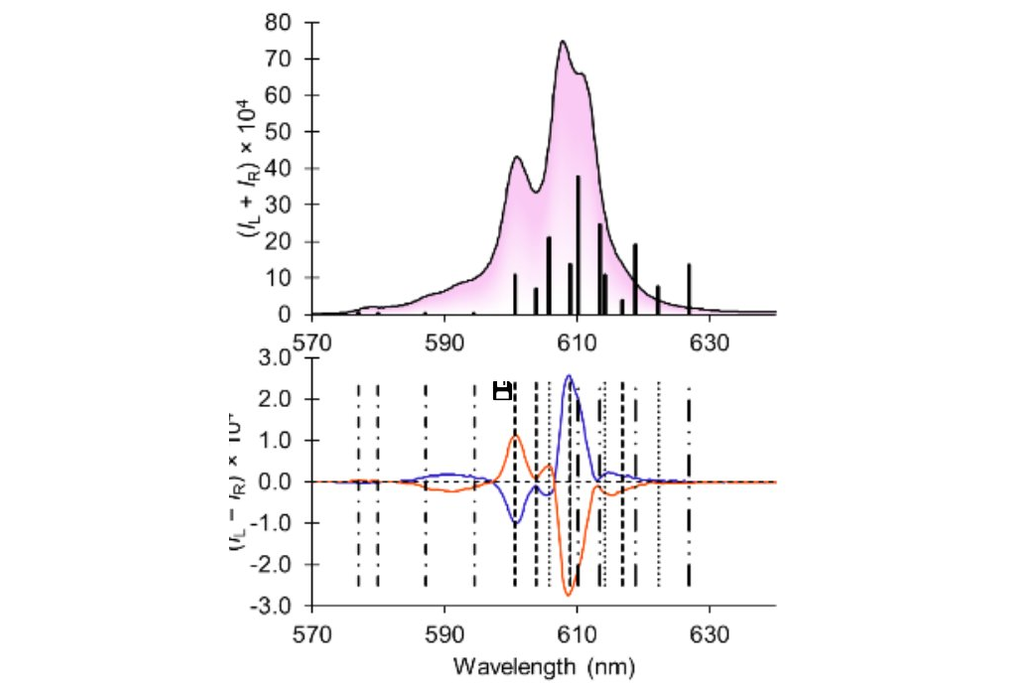
- Researchers in the Heavy Element Chemistry (HEC) program developed ligand-enabled circularly polarized luminescence (CPL) spectroscopy to directly resolve the electronic structure of americium (Am) and curium (Cm) complexes in solution, including the first observation of CPL in Am(III) and room-temperature mapping of crystal field splitting in Cm(III)
Significance and Impact
Research Details
- First observation of Am3+ CPL via ligand-sensitized energy transfer
- High-resolution Cm3+ CPL spectra allow direct mapping of crystal field splitting and electronic states at room temperature
- Ligand field symmetry and energy transfer pathways control emission intensity and chiroptical response
Publication Details
J. J. Woods; A. Peterson; J. A. Adewui; R. Lai; J. N. Wacker; R. J. Abergel; G. Ung, Chemical Science (2025).
Work was performed at Lawrence Berkeley National Lab, University of Connecticut, and in part by the Molecular Foundry.
