
Scientific Achievement
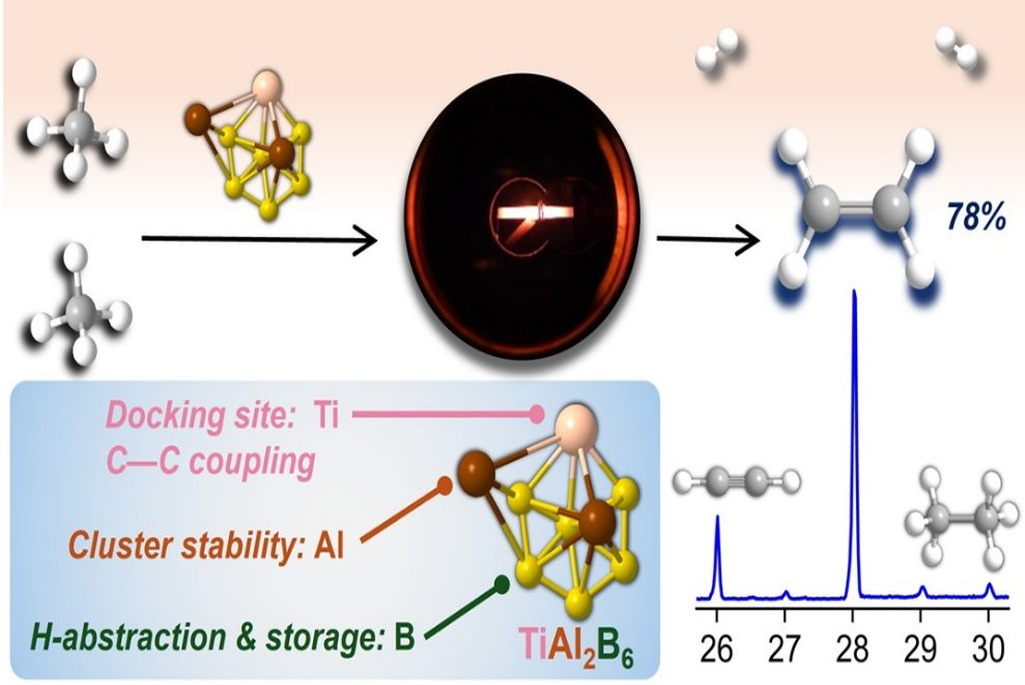
- Researchers in the Gas Phase Chemical Physics (GPCP) program discovered that atomically dispersed Ti–Al–B nanopowder enables low-temperature C–H activation in methane and saturated hydrocarbons, initiating methane coupling at 800 K (78% ethylene) and exo-C10H16 decomposition at 750 K
Significance and Impact
Research Details
- Combined catalytic microreactor experiments with synchrotron based mass spectrometry for operando detection of radicals and products
- Electronic structure calculations reveal synergistic roles: Ti activates C–H bonds, B stores hydrogen, Al stabilizes intermediates
Publication Details
S. Biswas, J. Cokas, W. Gee, D. Paul, N. Dias, H. W. T. Morgan, M. T. Finn, B. M. Hudak, P. M. Godbold, C. A. Klug, A. Epshteyn, A. N. Alexandrova, M. Ahmed, R. I. Kaiser, Nature Communications (2026).
DOI: 10.1038/s41467-025-62112-2
Work was performed at Lawrence Berkeley National Lab, University of Hawaii, University of California Los Angeles, and the United States Naval Research Laboratory.
