
Scientific Achievement
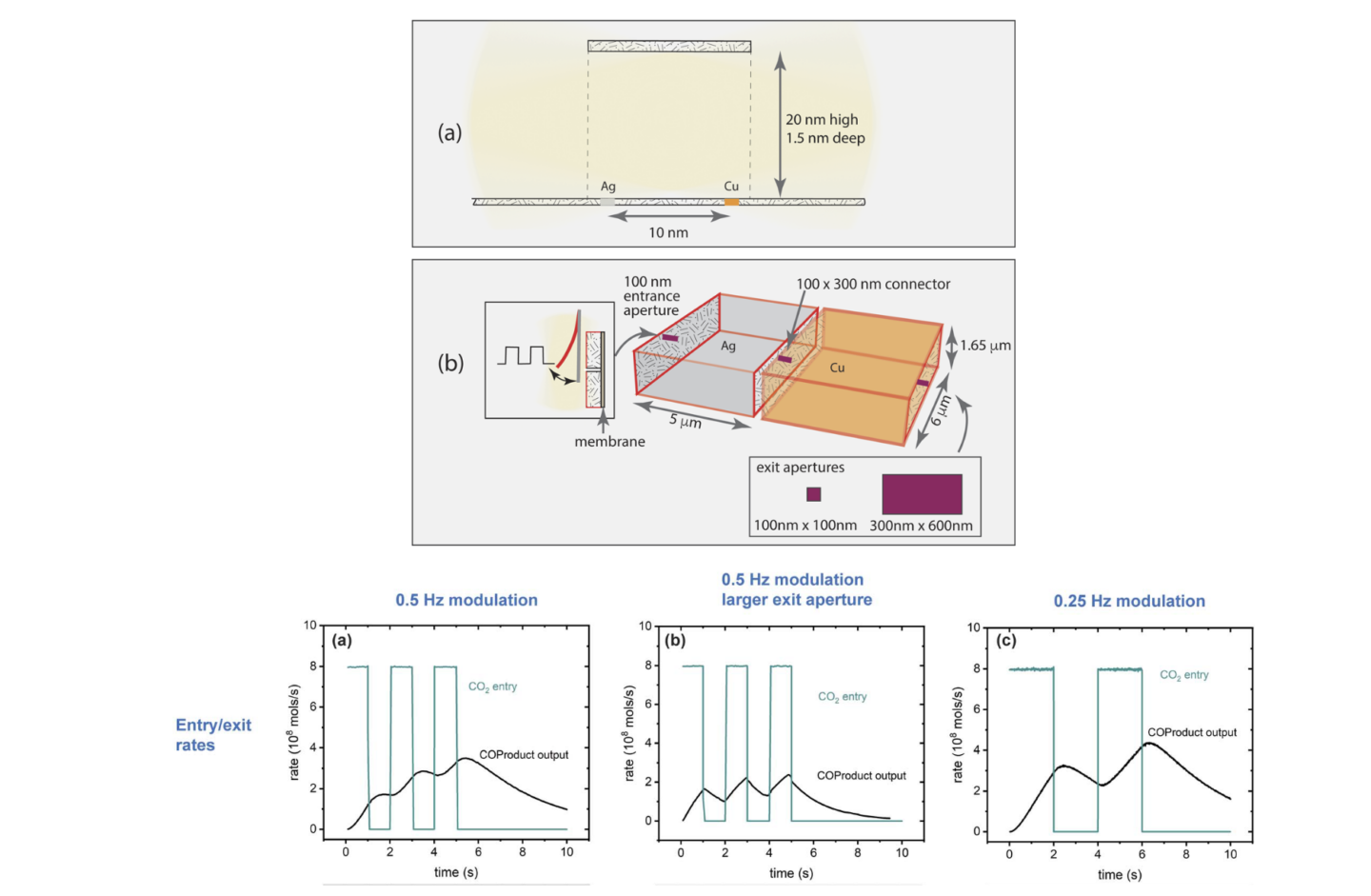
- A computational study of how principles from multi-step biological reactions (confinement, substrate channeling, directional diffusion and timing control) has been used to design an artificial, near 100% single pass conversion-efficient, catalytic cascade system for CO2 reduction to products
Significance and Impact
- Catalytic cascades are the most useful strategy for efficient and selective synthesis of products from reactants such as CO2. These are mainly designed as open flowing systems, which are highly inefficient. This work shows that bio-inspired design elements can overcome this drawback and lead to significantly improved chemical control
Research Details
- Stochastic reaction-diffusion kinetics simulations were used to simulate detailed chemistry over a broad range of space and time
- A simplified model (CO2/Ag) was used for the surface and solution phase CO2 reduction electrochemistry
- The model findings help identify how key biological functions work together within a system
F. A. Houle, P. Agbo, J. Yano, Chemical Science (2025).
Work was performed at Lawrence Berkeley National Lab.
