
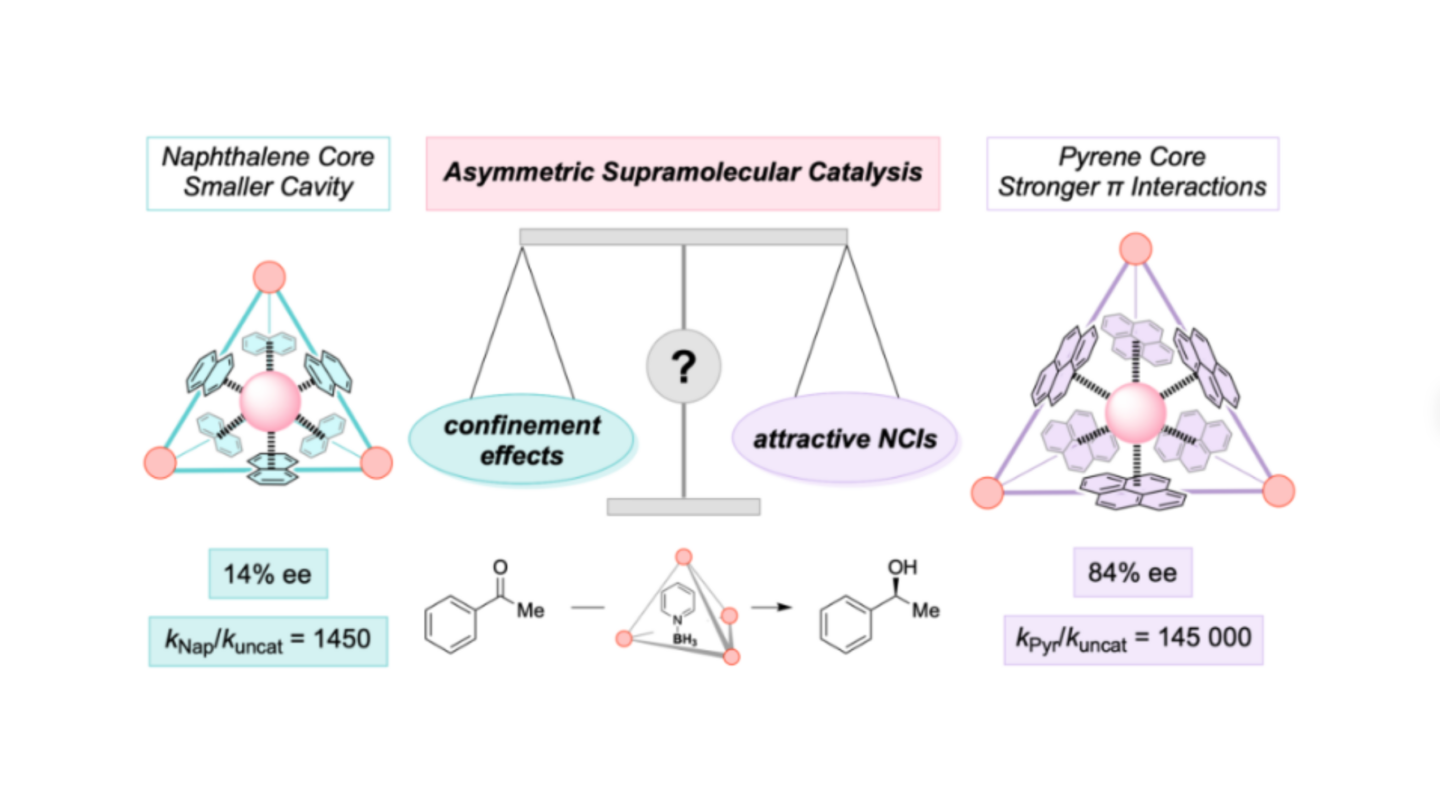
Scientific Achievement
- Researchers in the Catalysis (CAT) program identified relative contributions of attractive noncovalent interactionsand steric confinement in supramolecular host catalysis, which were demonstrated for the first time
Significance and Impact
- The remarkable catalytic performance of enzymes stems from their ability to engage in precise noncovalent interactions (NCIs) within a sterically confined space. Supramolecular catalysis seeks to emulate and understand these strategies through the rational design of simple and controlled catalyst microenvironments. While both steric confinement and attractive interactions have been invoked as key to host activity, their relative contribution to rate enhancement and selectivity, as well as potential trade-offs, remains an outstanding question. In this study, we address the question by systematically comparing two metal–organic supramolecular catalysts, which differ in the strength of their attractive non-covalent interactions and in their cavity volume
Research Details
- Showcased a pyrene-based host generally achieving better yields and enantioselectivity compared to its smaller naphthalene-based analogue, contradicting classical notions of confinement in catalysis.
- Performed a detailed mechanistic investigation, including temperature-dependent kinetics, supporting the pyrene-based catalyst being more active due to enhanced NCIs (substrate–host cation–pi with the aromatic walls)
- Established a correlation between experimental enantioselectivity and computational cation–pi interaction energies with the larger host’s pyrene wall
- Attributed the higher selectivity achieved with bulkier substrates in the smaller host as a result of steric confinement, demonstrating that analogous hosts can access distinct modes of catalytic activity and selectivity, much like enzymes
Publication Details
C. V. Craescu, C. D. David, E. D. Heafner, K. N. Raymond, R. G. Bergman, F. D. Toste, Journal of the American Chemical Society (2025).
Work was performed at Lawrence Berkeley National Lab.
