
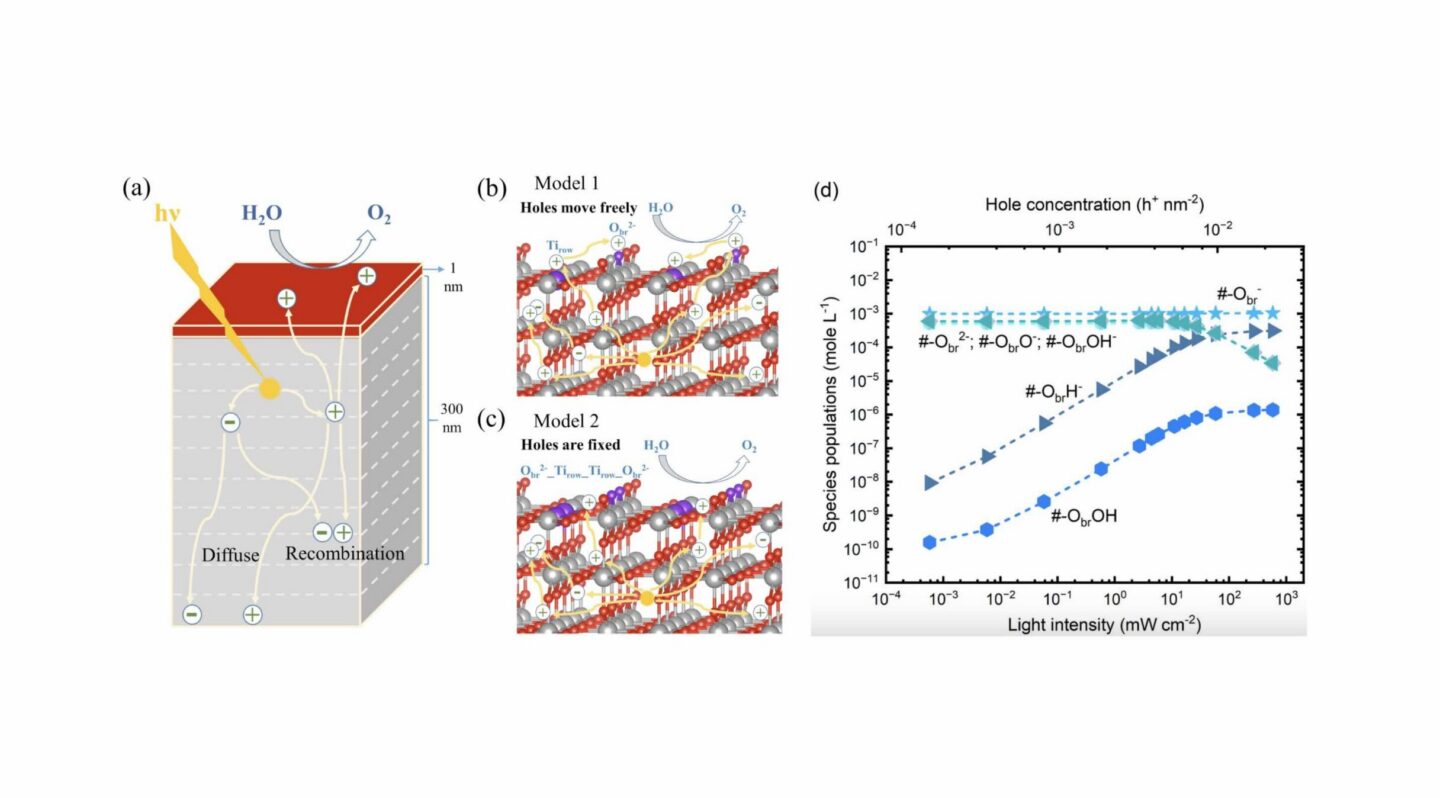
Scientific Achievement
- Researchers in the Solar Photochemistry program determined that photogenerated holes are immobilized by surface intermediates during light-driven water oxidation, and that thermal steps control the catalysis rate when light intensity exceeds a threshold. This computational study is the first to connect the detailed kinetics of surface reactions to diffuse light absorption in a semiconductor
Significance and Impact
- Photocatalytic water oxidation on oxide semiconductors is a core process for solar-to-chemical energy conversion, and is widely recognized to be slow. This study demonstrates that the rate is not only photochemically controlled and that acceleration of thermal steps may improve efficiency
Research Details
- Stochastic reaction-diffusion simulations of the detailed TiO2-driven photocatalytic water oxidation reaction over a wide range of light intensities
- Scenarios specifically examined the influence of mobile vs immobilized holes as well as the importance of high order kinetics in the reaction mechanism
P. Wang, G. Benitez, F. A. Houle, ACS Catalysis (2025.
Work was performed at Lawrence Berkeley National Lab.
