
Scientific Achievement
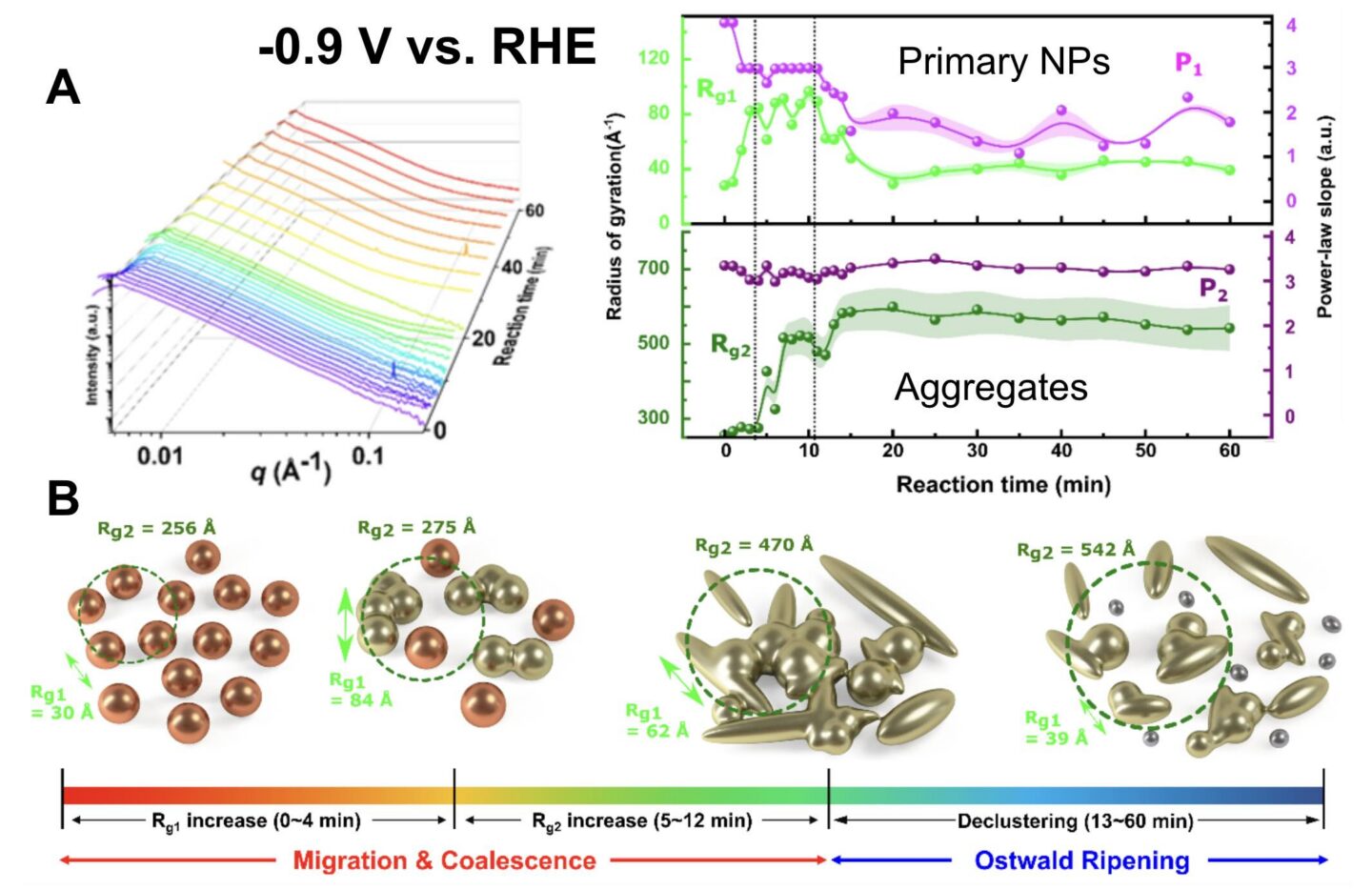
- Researchers in the Liquid Sunlight Alliance (LiSA) program identified the two competing degradation mechanisms for Cu-based CO2 reduction reaction (CO2RR) catalysts under a range of operating conditions
Significance and Impact
- Cu-based catalysts generate valuable multi-carbon products during CO2RR, but lose selectivity and activity quickly
- Quantitative understanding of the nanoscale restructuring mechanisms that control degradation will guide the design of more stable catalyst systems
Research Details
- 7 nm Cu oxide nanoparticles (NPs) electrocatalysts under various CO2RR conditions in a custom designed electrochemical cell
- In situ small agle X-ray scattering (SAXS) tracked the size and shape evolution during operation, identifying competing particle migration and coalescence (PMC) and Ostwald ripening (OR) mechanisms
- PMC dominates at lower overpotentials and earlier reaction times, whereas OR dominates at higher overpotentials and longer times due to rising local pH
S. H. Lee, J. E. Avilés Acosta, D. Lee, D. M. Larson, H. Li, J. Chen, J. Lee, E. Erdem, D. U. Lee, S. J. Blair, A. Gallo, H. Zheng, A. C. Nielander, C. J. Tassone, T. F. Jaramillo, and W. S. Drisdell, Journal of the American Chemical Society (2025).
Work was performed at Lawrence Berkeley National Lab, SLAC National Accelerator Laboratory, California Institute of Technology, National Renewable Energy Laboratory, University of Oregon, University of California Irvine, University of California San Diego, and the Stanford Synchrotron Radiation Lightsource.
