
Scientific Achievement
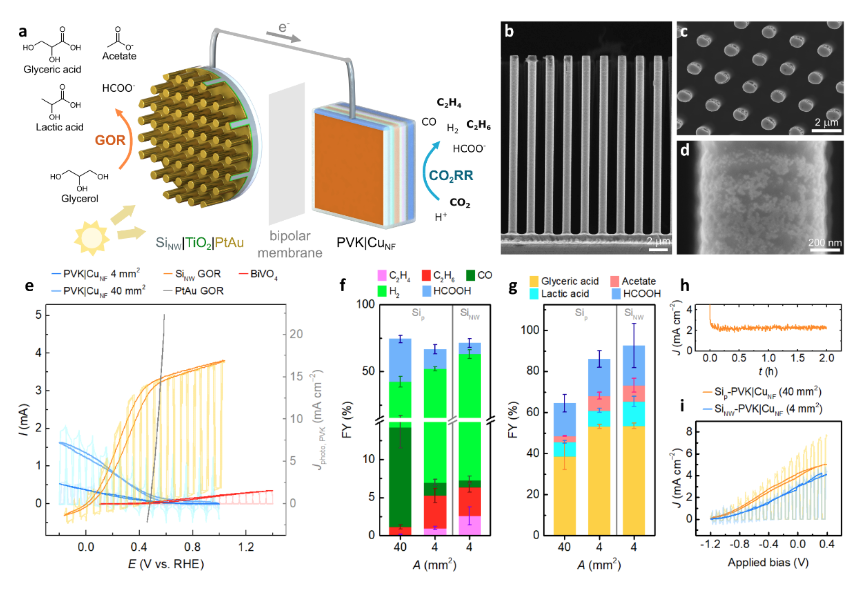
- Researchers in the Liquid Sunlight Alliance (LiSA) studied that using perovskites as light absorbers to increase photovoltage and an alternative anodic reaction replaces the oxygen evolution reaction (OER) in a photoelectrochemical system. This approach lowers voltage requirements, boosts current density, and enhances the solar-driven production of value-added multicarbon products
Significance and Impact
- The high thermodynamic demand for water splitting and the slow kinetics of the OER limit artificial photosynthesis applications
- Replace the OER with glycerol oxidation (GOR), reducing voltage requirements. Additionally, perovskite provides adequate photovoltage for CO2 reduction photocathode
- The GOR-coupled perovskite devices lower the voltage requirement, enhancing bias-free photocurrent density for C2 hydrocarbon production
- These results provide a proof-of-concept demonstration for simultaneous solar-driven multicarbon synthesis and biomass-derived waste conversion into value-added products, which may ultimately contribute towards a sustainable fuel and chemical economy
Research Details
- Integrated lead halide perovskite photoabsorbers with copper nanoflower electrocatalysts, achieving 9.8% Faradaic yield for hydrocarbons at 0 V vs. RHE
- The perovskite photocathode, paired with a silicon nanowire GOR photoanode, achieved unassisted photocurrent densities of ~2 mA/cm2 with ethane and ethylene Faradaic yields between 5% and 10% under 1 sun irradiation
