
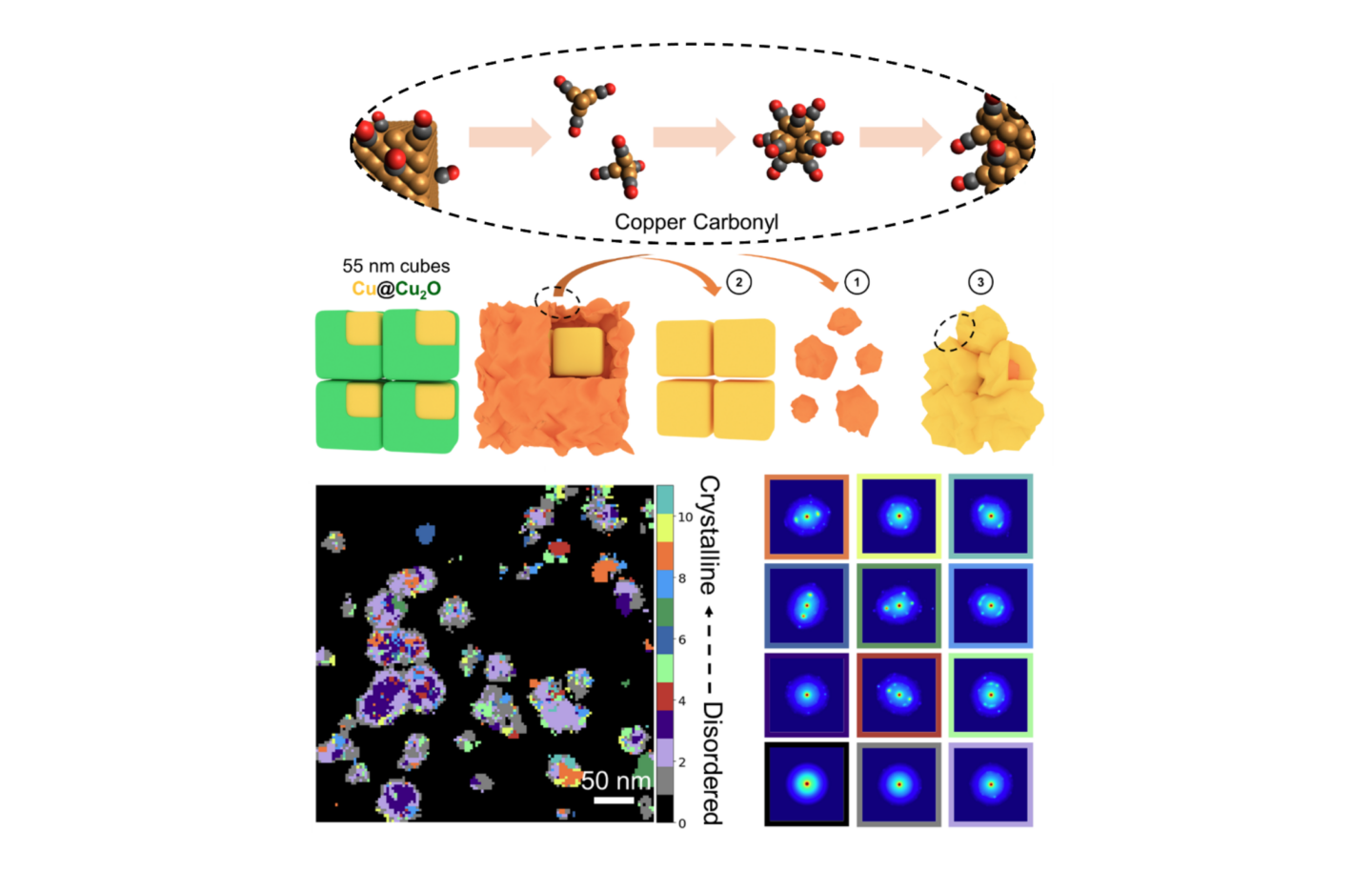
Scientific Achievement
- Researchers in the Atomic, Molecular and Optical Sciences (AMOS) program states that Copper carbonyl was identified as the molecular species responsible for dynamic reconstruction of electrocatalysts during the CO2 reduction reaction
Significance and Impact
- Understanding the (de)activation mechanisms of electrocatalysts enables researchers to design materials that are more stable, active and selective towards the desired products
Research Details
- Operando 4D-STEM, assisted by machine learning, and high-energy-resolution fluorescence-detected (HERFD) X-ray absorption spectroscopy (XAS) were used to track the crystal structure and oxidation state of Cu nanocubes, revealing the transition of single-crystal Cu@Cu2O to metallic copper nanograins during CO2 electroreduction. Operando Raman and extended X-ray absorption fine structure (EXAFS) tracked the evolution of *CO adsorbed on a model single-atom catalyst into first *CO-covered small clusters and eventually nanoparticles
Publication Details
Yang, Y.; Feijóo, J.; Figueras-Valls, M.; Chen, C.; Shi, C.; Guzman, M. V. F.; Maombi, Y. M.; Liu, S.; Jain, P.; Briega-Martos, V.; Peng, Z.; Shan, Y.; Lee, G.; Rebarchik, M.; Xu, L.; Pollock, C. J.; Jin, J.; Soland, N. E.; Wang, C., Salmeron, M. B.; Chen, Z.; Han, Y.; Mavrikakis, M.; Yang, P. Nature Catalysis (2025).
DOI:10.1038/s41929-025-01359-w
Work was performed at Lawrence Berkeley National Lab, theCornell University, and in part at the Advanced Light Source, the Molecular Foundry, and NERSC.
