
Scientific Achievement
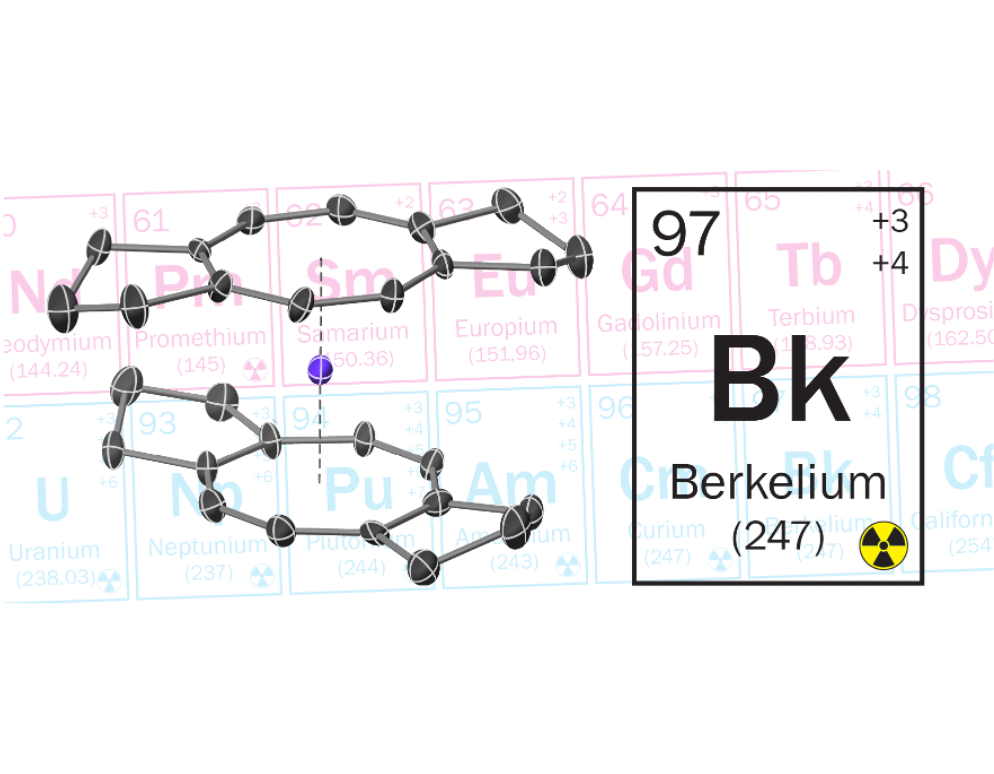
- Researchers in the Heavy Element Chemistry program determined that metal–carbon bonds were formed in an organometallic complex with the transplutonium element Berkelium (Bk) for the first time since its discovery in 1950
Significance and Impact
- The work contradicts longstanding models suggesting that behavior of the later actinides mirrors that the lanthanides, and impacts the design of selective extractants for nuclear fuel reprocessing
Research Details
- The extremely oxygen- and water-sensitive complex was formed from 0.3 mg of 249-Bk using unique facilities for handling of air-sensitive and radioactive materials
- Electronic structure calculations show that the tetravalent Bk ion is stabilized by overlap between ligand and Bk 5f orbitals, which is not present for lanthanides
- The collaboration leveraged the expertise of students, postdocs, and six PIs from LBL’s Heavy Element Chemistry program
Publication Details
Russo, D. R.; Gaiser, A. N.; Price, A. N.; Sergentu, D. C.; Branson, J. A.; Wacker, J. N.; Katzer, N.; Peterson, A. A.; Branson, J. A.; Yu, X.; Kelly, S. N.; Ouellette, E. T.; Arnold, J.; Long, J. R.; Lukens, W. W.; Teat, S. J.; Abergel, R. J.; Arnold, P. L.; Autschbach, J.; Minasian, S. G. Science (2025).
Work was performed at Lawrence Berkeley National Lab, the Advanced Light Source, and the University of Buffalo.
