
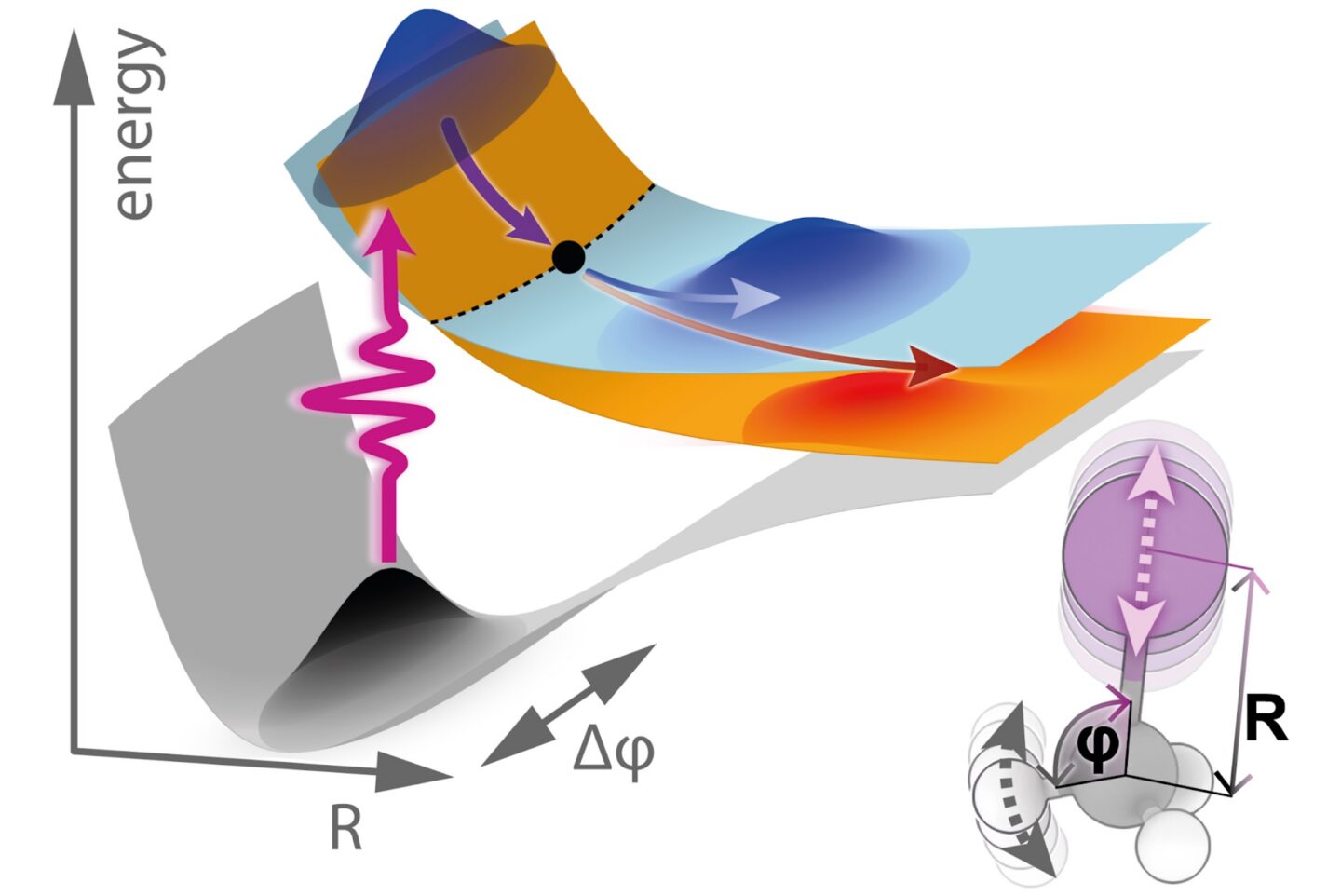
When molecules absorb ultraviolet light, their electrons and nuclei can evolve in a strongly coupled, quantum-mechanical way. These dynamics are often governed by conical intersections—regions where electronic potential energy surfaces of a molecule meet and rapidly redirect chemical reactions. At such intersections, a molecule’s nuclear wave packet, the quantum-mechanical description of how atoms in a molecule move together, can split between electronic states, generating short-lived quantum coherences that influence reaction outcomes. Until now, these coherences were thought to vanish as molecules break apart.
In a new Physical Review Letters study, researchers from the Chemical Sciences Division at Lawrence Berkeley National Laboratory (Berkeley Lab) and collaborating institutions challenge that assumption. Through detailed quantum simulations of ultraviolet light-excited methyl iodide (CH₃I), the team shows that an electronic coherence created at a conical intersection can partially survive molecular dissociation. Remarkably, part of the original vibronic coherence—shared between electronic and nuclear motion in the molecule—is transferred to the iodine atom after bond cleavage, where it persists as a long-lived electronic spin–orbit coherence.
The calculations predict that roughly one-third of the coherence generated in the molecular regime survives in the dissociated iodine fragment, where vibrational motion can no longer cause decoherence. To track this process in real time, the authors propose a tabletop spectroscopic approach—heterodyned attosecond four-wave-mixing spectroscopy—that combines sub-femtosecond time resolution with electronic-state specificity and enhanced sensitivity to extremely small coherences.
Beyond revealing an unexpected pathway for coherence preservation in photochemical reactions, the work introduces a powerful strategy for directly measuring electronic coherences generated at conical intersections. By enabling complete reconstruction of these coherences in time, the approach opens new opportunities to understand—and potentially control—nonadiabatic dynamics in complex molecular systems.
Funding: At LBNL, this research was supported in part by the DOE Office of Science’s Atomic, Molecular, and Optical Sciences Program of the Division of Chemical Sciences, Geosciences, and Biosciences.
Researchers: P. Rupprecht, N.G. Puskar, D.M. Neumark, and S.R. Leone (Chemical Sciences Division, Lawrence Berkeley National Laboratory, and University of California, Berkeley); F. Montorsi and M. Garavelli (Università di Bologna—Alma Mater Studiorum); L. Xu and N. Govind (Physical and Computational Sciences Directorate, Pacific Northwest National Laboratory, and University of Washington); S. Mukamel (University of California, Irvine); and D. Keefer (Max Planck Institute for Polymer Research).
Publication: P. Rupprecht, F. Montorsi, L. Xu, N. G. Puskar, M. Garavelli, S. Mukamel, N. Govind, D. M. Neumark, D. Keefer, S. R. Leone, Tracing long-lived atomic coherences generated via molecular conical intersections, Phys. Rev. Lett. 135, 233201 (2025).
