
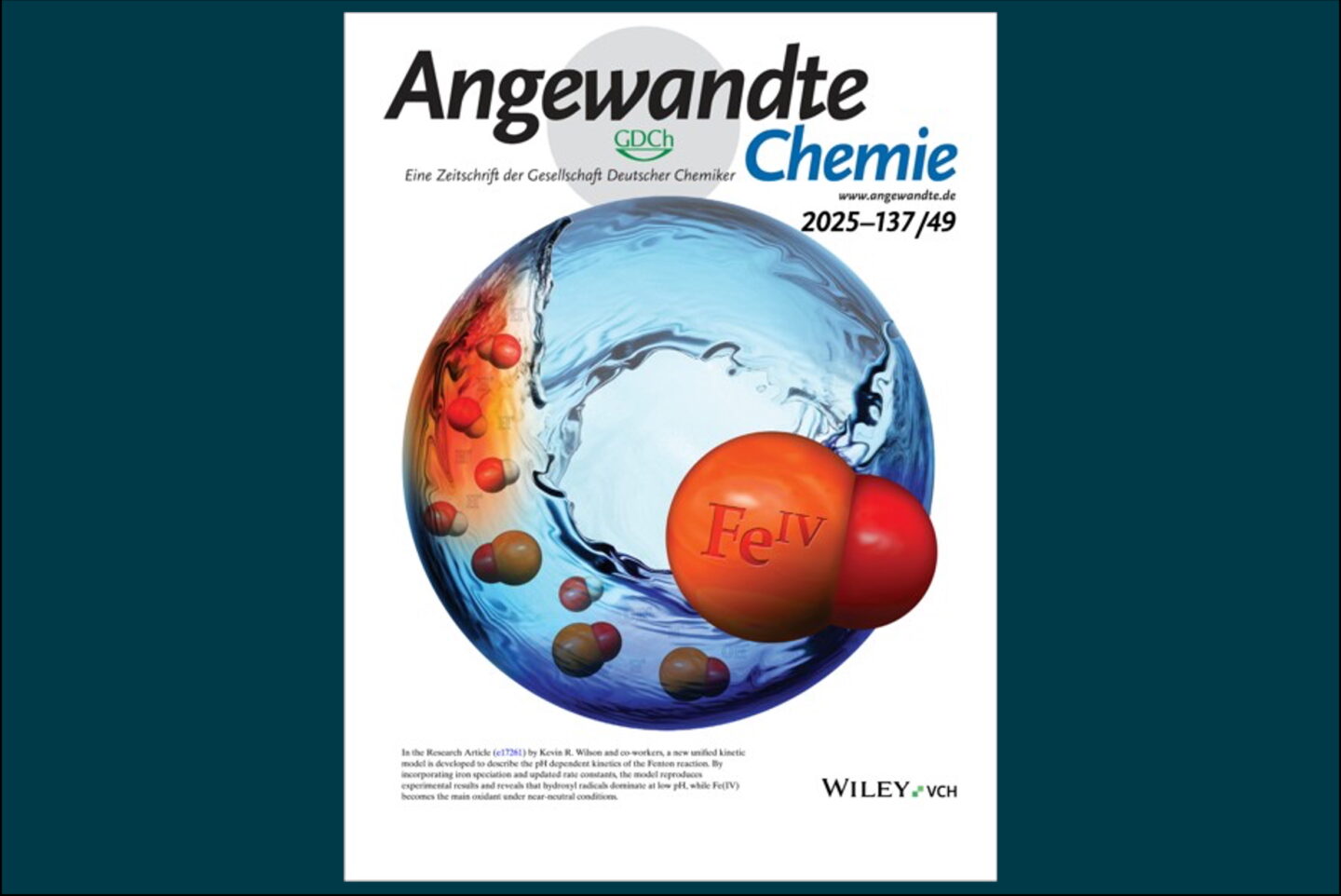
For more than a century, chemists have relied on the Fenton reaction – the oxidation of iron by hydrogen peroxide – as an important source of reactive oxidants. The chemistry underlies advanced oxidation processes for wastewater treatment, governs the fate of organic molecules in natural waters and the atmosphere, and plays a role in biological pathways linked to oxidative stress and cell death. Yet despite its ubiquity, the fundamental mechanism of the Fenton reaction, particularly how it changes with pH, has remained unresolved.
In a new study, researchers in Berkeley Lab’s Chemical Sciences Division present a unified kinetic model that clarifies how the reaction mechanism shifts from acidic to near-neutral conditions. The work, featured on the back cover of Angewandte Chemie International Edition, shows that accurately accounting for iron speciation, a long-recognized but often simplified aspect of the chemistry, is essential for understanding Fenton reactivity. When iron speciation is treated explicitly, the analysis reveals that the formation of a highly reactive iron(IV) intermediate at near-neutral pH must occur far more rapidly than previously assumed.
By reanalyzing prior experimental data and integrating thermodynamically consistent iron and radical equilibria, the researchers demonstrate that iron(IV) pathways are necessary to explain the pronounced increase in reaction rate observed as pH approaches neutral values. The resulting model quantitatively reproduces experimental kinetics across a broad pH range, resolving contradictions among decades of earlier studies and reconciling competing mechanistic interpretations.
Beyond settling a long-standing debate in fundamental chemistry, the work provides a predictive framework for describing iron-driven oxidation in realistic systems. The ability to model how pH and iron speciation control oxidant formation has implications for environmental remediation technologies, atmospheric and aquatic chemistry, and biological redox processes. More broadly, the study establishes a mechanistically consistent foundation for designing and evaluating iron-based oxidation chemistry in complex chemical environments.
Funding: This work was supported by the Condensed Phase and Interfacial Molecular Science Program (CPIMS), in the Chemical Sciences Geosciences and Biosciences Division of the Office of Basic Energy Sciences of the U.S. Department of Energy under Contract No. DE-AC02-05CH11231.
Researchers: L. Cohen and K.R. Wilson (Chemical Sciences Division, Lawrence Berkeley National Laboratory, and University of California, Berkeley); and M.D. Willis (Department of Chemistry, Colorado State University).
Publication: L. Cohen, M.D. Willis, and K.R. Wilson, Iron(IV) formation and the pH dependent kinetics of the Fenton reaction, Angew. Chem. Int. Ed. 2025, e17261.
DOI: 10.1002/anie.202517261
